

Good morning from the countryside!
There are many of us who are passionate about agriculture, so much so that those who have the opportunity to manage a small vegetable garden plant and sow everything possible: fruit trees, olive trees, and then vegetables and more vegetables!
It always starts out as a family vegetable garden, but in reality, when we plant tomatoes or pumpkins, we plant too many ‘because I’ll just give them away to someone!’
Well, it is precisely from this super production that advantages and therefore profits can often be derived.
In fact, if you cultivate a large amount of land and therefore have abundant harvests, you can, or perhaps should, consider starting a small farm.
Of course, it seems easy to say, but how do I put it into practice? Let’s see if I can give you some tips!
Let’s start by saying that in order to officially sell your vegetables, fruit, eggs or anything else that comes from your agricultural experience and hard work, you must be registered as a farm or have an agricultural VAT number. They are similar but different, but I will discuss this in other articles.
In principle, a private individual may donate their harvest without monetary exchange. Then everyone manages their own garden as they wish!
Agricultural businesses span many sectors. If you think about it, everything around us and everything that is part of our daily lives comes from the world of agriculture, and we can identify three macro categories:
Having made this necessary clarification, we can now identify the two main channels, which we can conveniently group as follows: Wholesale and Retail.
We are talking about farms, in fact. more or less small, and as such, they must seek out and identify the right sales channels to sell everything they grow; to do this, there are some important details to consider when making decisions. The time you spend growing is crucial, but you also need to think about the time you spend packaging and selling your products, which I can assure you is just as important.
When we talk about wholesale, we get scared because we always think of supermarkets, but in reality we can include other less demanding (at least economically) entities in this category, such as local cooperatives, general markets or traders. However, I would say that these are paths to take once the company is well structured and large.
My impartial advice, however, is this: STAY SMALL!
Yes, I may seem unambitious, but I assure you that in agriculture, if you stay at a family-run scale, you have more profit margin, fewer expenses, better management of your work, and definitely a little more time for yourself! Oh, I almost forgot, definitely fewer problems!
At this point, therefore, detail is the most suitable and profitable solution for a small farm, which can still sell to restaurants, small fruit and vegetable shops, weekly markets and DIRECT SALES.
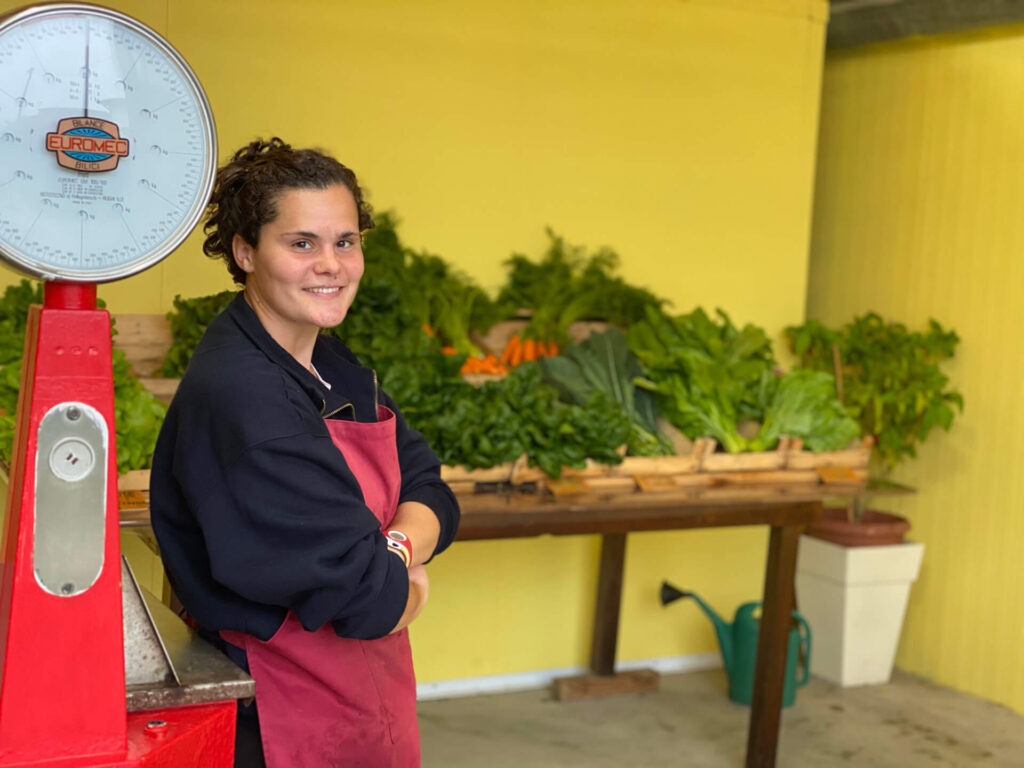
This is the type of sale I have chosen given the small size of my company, and I assure you it is an excellent system. Direct sales can be carried out either at your farm, as I do, or by going to local markets, or both. The choice is entirely personal but dictated by very specific constraints. In fact, while for on-farm sales you only need to equip yourself with a counter, a scale, a few other sales accessories, and a sheltered place to carry out the sale, to sell at markets you need all of this plus a van or some other suitable means of transporting vegetables (which may be wet) and, above all, you need TIME!
This is no small matter if you consider that your time has a cost and that taking it away from farming could be detrimental. So let’s say that this solution is suitable for those who have time and people available.
In my opinion, direct sales at the farm, as I do, are always the best way to go, and even better if done exclusively, selling only products that you grow yourself without purchasing anything else elsewhere.
My greatest joy in selling agricultural products comes from knowing that what I deliver to the customer is grown exclusively by me! I don’t buy any vegetables from farms to resell at my stall, because I know that customers trust my products. Surely every farm works in a precise manner, complying with the relevant laws, but I can only be certain about my own vegetables. This means that I sometimes go through periods of low production and therefore low sales, but I prefer to ensure that my customers have vegetables grown by me every day.
That said, since 2007, the Ministry of Agriculture and Forestry has recognized that each farm has the possibility to sell 51% of its own products and 49% of products purchased from other farms.
So you can sell your vegetables, and if you think you don’t have enough, you can buy some from others and resell them, but honestly, I like being a farmer, not a merchant!
To start selling directly, you need to send a simple notification to the municipality indicating the location, address, and reason for the sale. To sell directly at markets, the organizers or the municipality itself will issue you with a permit.
It’s often everyone’s problem. “Yes, I grow it, but then I don’t know how to let people know.” It’s a legitimate question to ask yourself, but don’t despair, especially in the age of social media. My journey was actually the opposite, because first I showed on social media (FACEBOOK) how I worked and how I harvested, and then people started asking me if I sold my produce. Slowly but surely, I decided to set up my first stall in front of the vegetable garden to start selling. Word of mouth is another fundamental way to promote your products, and if you do a good job, there’s no doubt that it will spread quickly.
I assure you that the effort you put into growing, packaging, and then selling your vegetables is reflected in the compliments you receive from customers as much as in the financial aspect of the sale itself.
Hearing someone who buys your carrots say that they have rediscovered the flavors of the past, rather than being surprised by the taste of tomatoes or salads because they don’t even remember them, or even saying “finally, this strawberry tastes like a strawberry,” repays you for your daily efforts; these are satisfactions that a shopkeeper will never be able to experience.
You need consistency and commitment every day, you need seriousness and honesty, this is what the customer is looking for from you! Elsewhere, they may find everything at lower prices, but they don’t always find these virtues; I assure you that in the long run, your results will come, even financially.
Economic yield is clearly determined, but in agriculture it is difficult, if not impossible, to predict! While those who work in wholesale have the opportunity to make agreements with buyers on prices (usually low), quantities, and varieties to grow, things get complicated for those who decide to sell directly. In fact, it is necessary to grow more varieties of products in order to offer customers a full and diversified selection. This requires meticulous planning, which is always difficult to stick to due to the weather and other factors such as soil, fertilization, etc. So while with wholesale you know that what you produce (hopefully) should all be purchased and paid for, with direct sales you have to budget for periods when there are no products available. In my opinion, this is not a bad thing, because it is certainly better to sell a small amount of well-grown produce at higher prices and perhaps have some free time, than to cultivate hectares of land to sell at low prices in the hope that everything will go well!
My name is Francesca and I am 33 years old. I like to share my life in the countryside in a simple and spontaneous way, just as this adventure began.

Iscriviti alla nostra newsletter e ottieni subito un coupon di sconto del 10% da utilizzare sul tuo primo ordine come regalo di benvenuto!