

Good morning from the countryside!
Since the Middle Ages, this practice was used as a two-year rotation of wheat and fallow land, then as a rotation of cereals, which were usually divided into three- or four-year rotations, almost always including fallow land. CLOVER (legume) is often included as a green manure crop if fallow land is not used.
Intensive farming has somewhat relegated this practice to oblivion, but it has been rediscovered by organic farmers and is still used by those who farm in a traditional and sustainable manner.
Essentially, we can talk about three important effects that this agricultural practice has on the soil:
The practice of crop rotation undoubtedly produces significant environmental benefits, such as:
They can usually be divided into two main categories, in order to understand how crop rotation has a positive effect on the soil:
Legumes (beans and peas) actually enrich it because they fix nitrogen from the atmosphere into the soil.
Having made this necessary introduction, which may not be necessary for those who have a vegetable garden but which I felt was important in order to provide some information, let us try to address the issue of crop rotation or rotation more specifically related to horticulture.
To better understand what we are talking about, we can simplify the cultivation systems (whether we are talking about vegetables or cereals) into two types. The first:
MONOCULTURE (e.g. rice); this system certainly has lower investment and management costs (machinery) and is used throughout the livestock industry (corn-based feed and fodder).
However, this type of solution also has weaknesses, such as:
– a reduction in yield per unit area
– it facilitates the establishment of pathogens, whether fungi or insects
– it promotes a possible deterioration in the physical condition of the soil
– it may require cultivation at unsuitable times (heavy soils).
The solution adopted by our company is a mixed crop system.
The second system, which is more commonly used for vegetables, is:
MULTICULTURAL (More common on ordinary land), this system allows:
– crop rotation
– distribution of agronomic interventions over time
– reduction of economic risks on different crops,
– better control of pest attacks.
The weaknesses, if we can call them that, of this system are:
– it requires constant commitment throughout the year
– it requires greater professional skills
– it requires a variety of equipment
Having made this necessary distinction, which helps us understand what we are talking about, we can now delve into the specifics of the POLYCULTURAL system, which is divided into:
– CONSOCIATIONS (which we will discuss in another article)
– ROTATIONS OR CHANGES
At this point, tired of too many technical considerations, I think it is necessary to go into detail and try to shed light on how to adopt crop rotation in the garden. In reality, we have two types of crop rotation:
1 – CLOSED-CYCLE ROTATION, which involves a fairly rigid vegetable rotation scheme with cycles ranging from 3 to 5 years, but is usually used more for cereals and fodder legumes and, in any case, large plots of land.
2 – FREE ROTATION, which always takes into account the principles of rotation but is easier to manage and is mainly aimed at vegetables and vegetable gardens. With this system, we can choose different types of rotation divided by type, which is what I will explain here.
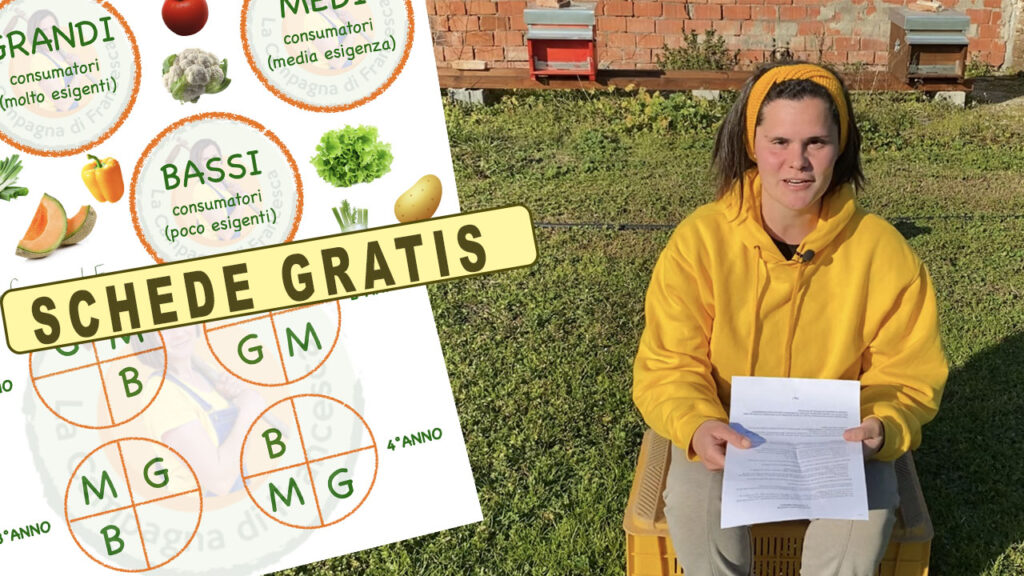
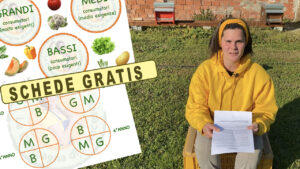
LARGE CONSUMERS (VERY DEMANDING) PREPARERS
-Cabbage (except kohlrabi)
-Cucumber
-Aubergine
-Tomato
-Pepper
-Potato
-Melon
-Chilli pepper
-Turnip
-Mustard
-Pumpkin
-Watermelon
AVERAGE CONSUMERS (AVERAGE NEEDS)
-Garlic
-Red beets
-Swiss chard
-Kohlrabi
-Carrots
-Chicory
-Onions
-Fennel
-Leeks
-Radishes
-Lettuce
-Celery
-Spring onions
-Spinach
They can be cultivated in the same soil the following season because they will utilise the remaining resources, but rotating between them
LOW CONSUMERS (NOT VERY DEMANDING). IMPROVERS
-Beans
-Green beans
-Broad beans
-Peas
-Chickpeas
-Peanuts
-Soya beans
Legumes in particular increase soil fertility as they are nitrogen fixers.
-CRUCIFERS OR BRASSICAS: cabbage, turnips, radishes, rocket, mustard (2-year interval)
-FABACEAE OR LEGUMES: Beans, green beans, peas, soybeans (2-year interval)
-SOLANACEAE: tomatoes, aubergines, peppers, potatoes (3-year interval)
-APIACEAE OR UMBRELLIFERAE: fennel, carrots, parsley (3-4 year interval)
-CHENOPODIACEAE: spinach, Swiss chard, beetroot (3–4-year interval)
-ASTERALES OR COMPOSITE: lettuce, radicchio, artichokes, cardoons (2-3 year interval)
-CUCURBITACEAE: courgette, pumpkin, cucumber, melon (3-year interval)
-ROSACE: fragola, lamponi (intervallo 2/3 anni)
-LAMIAceae: rosemary, thyme, sage, basil (3-4 year interval)
LILIACEAE: garlic, onions, leeks (3-year interval)
Adesso, se ancora non l’hai fatto, ti consiglio di andare a dare un’occhiata alla scheda che ho preparato! Stampala e guardala all’occorrenza ????
See you next time!
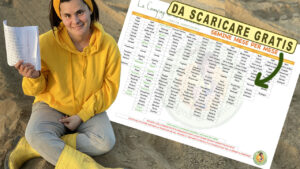
A handy table in which I have summarised, month by month, the ideal periods for transplanting.
Fill in the form and you will receive a link to download the file!
My name is Francesca and I am 33 years old. I like to share my life in the countryside in a simple and spontaneous way, just as this adventure began.

Iscriviti alla nostra newsletter e ottieni subito un coupon di sconto del 10% da utilizzare sul tuo primo ordine come regalo di benvenuto!