

Good morning from the countryside!
We often think about planting and sowing, identifying areas where to grow fruit or others to leave uncultivated, but in reality, the first thing to do is always to think about the irrigation system. Of course, the autumn and winter months mean we don’t have to water constantly, so we can take some time to think about and install a new irrigation system, but I can assure you that in summer we often struggle to find useful and quick ways to water our vegetable garden!
So, once we have studied the right way to irrigate, we have already made our work easier. In fact, once we have identified whether and how to water certain vegetables, we can build a system that we can then reuse on similar vegetables in the same season or reuse in the next season!
Every vegetable has its own “preferred” irrigation system, which often does not match our needs, almost always because we want to rush through everything, whereas the vegetable garden requires consistency and patience.
To simplify matters, we can divide irrigation into two types: bottom and top, but these are not suitable for all vegetables.
For leafy vegetables such as lettuce and salads in general, radicchio, chicory and chard, rocket and parsley, watering from above can be excellent and quick, even for onions, carrots, beetroot, potatoes, celery and many others. There are mainly two types of overhead irrigation: sprinkler irrigation and micro-irrigation.
For fruit vegetables such as tomatoes, aubergines, peppers, green beans and beans, peas, broad beans, all types of cabbage, strawberries, cucumbers and others, bottom irrigation systems are recommended. There are essentially three valid systems for this: micro-perforated hose, drip tape or localised sprinklers.
Once we have identified the vegetables that need watering, we can proceed to install an effective irrigation system. In this case, we need a good overhead watering system, but not a sprinkler system, which creates large drops that press down on the soil when they hit the ground and could damage light vegetables such as rocket or lettuce.
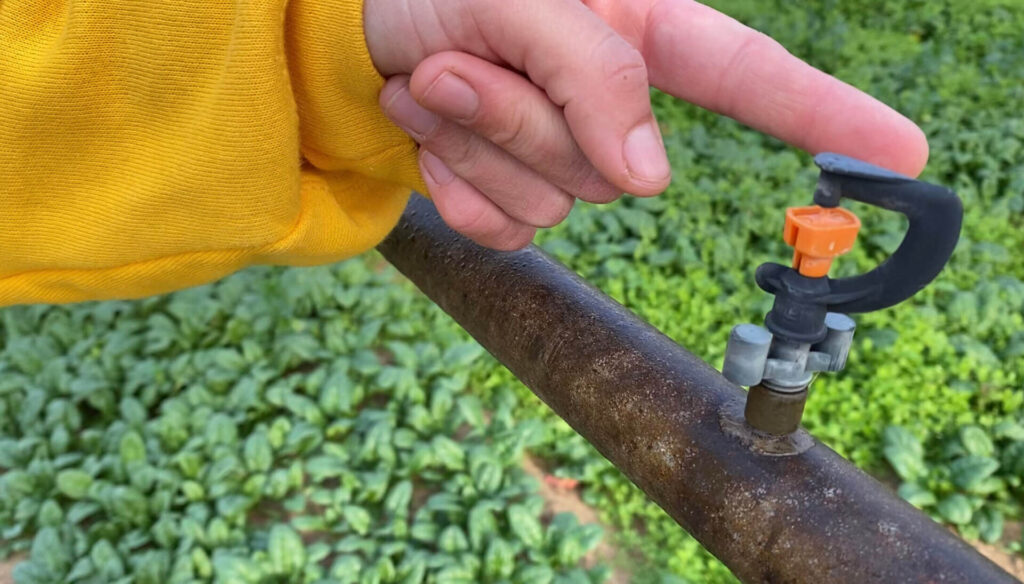
Instead, I use a micro-irrigation system from above, which allows me to cover a wide area of cultivation with micro-droplets of water, almost like a mist, so as not to damage the vegetables.
The system is simple, convenient and fast, so much so that you will want to use it throughout your entire garden, but as I said, EVERY VEGETABLE NEEDS THE RIGHT IRRIGATION.
I use 32 mm (1/4 inch) diameter metal pipes that are 5 metres long and perforated every 1.5 metres, with a female connector at one end and a male connector at the other. Identical PVC pipes are also available, pre-perforated.
To secure them, you can use wooden or iron stakes. I use iron ones because they are practically eternal, well planted in the ground at least 30/35 cm deep and at least 1 metre high above ground. For greater stability, given that it has to support a pipe full of water for a long time, it is ideal to apply a plate at a point between 30 cm below ground and 1 metre above ground (as you can see in the video).
Each pipe has three micro-sprinklers with rotating plastic heads, which in this case cover a radius of eight metres, but smaller ones are also available on the market, starting from one metre upwards.
Micro-irrigators or sprinklers have a fixed threaded part screwed onto the pipe and an interchangeable upper part, depending on requirements.
Once all the pipes have been laid out, simply connect the male/female ends and you’re done! A cap on one end and a quick-connect elbow to connect the water hose holder, and you’re ready to water.
If you use PVC pipes, however, you cannot get away with simply using stakes! No, you need a structure, usually a wire, to which you can tie the PVC pipe, otherwise it will twist completely. It should also be noted that, being plastic, it suffers from extreme cold and heat, so it is likely to deteriorate more quickly.
The advantages are undoubtedly the ease and practicality of installing the overhead irrigation system with iron pipes, which is also convenient when dismantling and storing it for the winter.
It can be adapted to different watering areas thanks to nozzles (micro-sprinklers) with variable diameters, from 1 to 8 metres.
It does not deteriorate over time, or in any case has a very long life. My pipes are over 40 years old and are still in perfect condition.
It can be assembled and disassembled to the desired length whenever we want.
If you can call it a flaw, I must point out that it is especially useful for larger crops.
The right decision is to prevent as many problems as possible for the plants, and the irrigation system is essential in preventing fungal diseases. In fact, while leafy vegetables and perhaps short-cycle vegetables such as We can opt for this type of solution for salads, but for tomatoes and all other fruit vegetables, this system would prove to be a complete enemy.
The droplets would settle on plants and stems, causing moulds such as downy mildew and botrytis, as well as rotting cabbages, cauliflowers and broccoli. Basil could also be affected by a blackish leaf mould that has recently been damaging crops.
So now you have a clearer idea, I hope, so get started early on planning your irrigation systems in anticipation of the next season!
See you next time!
My name is Francesca and I am 33 years old. I like to share my life in the countryside in a simple and spontaneous way, just as this adventure began.




Iscriviti alla nostra newsletter e ottieni subito un coupon di sconto del 10% da utilizzare sul tuo primo ordine come regalo di benvenuto!